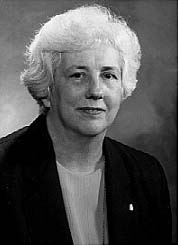
Sohl
Give us this day...
Joyce Sohl examines the Lord's Prayer as 'our daily bread' at Jubilee
By Review Staff
The Lord"s Prayer (The "Our Father" to our Catholic friends) is the most important prayer in Christian tradition. More than 2,000 year old, it was Christ's simple response to his disciples request. Teach us to pray. During the entire Jubilee 2000 week, the short, 64 word prayer (65 if you count, "Amen") was illuminated phrase by phrase by some of the best minds in the Conference, and in United Methodism. Each presenter read and reflected on a different phrase.
|
|
|
Sohl
|
Thursday morning, Aug. 10, the phrase was "Give us this day, our daily bread." Joyce Sohl, Deputy General Secretary, Women's Division of the General Board of Global Ministries opened her examination with the setting of the prayer: "In Luke, Jesus was praying and, when he finished the disciples asked him to teach them to pray and he gave them this prayer." "In Matthew, the setting is somewhat different. For the prayer is part of the teachings of Jesus that starts with the Beatitudes. Jesus admonishes his listeners, to pray in ways far different than those of the Jewish leaders or the Gentiles - don't pray for show nor pray a series of empty and many worded phrases."
"I contend that we who call ourselves Christians have messed up these teachings of Jesus over and over again."
"Many of the public prayers I have heard recently were more show than substance; more about the individual praying than the issues and needs of the community," she said. "Jesus gave us this prayer. It honors and recognizes God as Creator, deliverer and lover of the world and it acknowledges that God has a vision of what the world should be," Sohl said.
"But it is also a series of petitions that starts with very strong verbs - almost commands; give us, forgive us, save us. There is no nice language like please, no begging or whining allowed - it is clean and very clear."
"Give us this day our daily bread - the first of these petitions acknowledges that God is the source of all - that we are dependent on God for all of our daily needs - food, shelter, health, clothing. But," said Sohl, "'Give us this day our daily bread" is not just about my individual needs. Note, that singular words are not allowed in this prayer - it is us, not me and our, not my."
She said one radio preacher caused her to about jump out of her seat by starting with "My father." "When we pray this prayer we are asking God to grant the basic needs to all God"s children. We are acknowledging that every person has a right to and deserves to have their daily needs met," she insisted. "No one person or group should have their needs met, while others go hungry or are homeless or don"t have access to health care. This is real sticky for us who live in an affluent society - it requires that we pray for those who are without whether they live next door or in another country."
"The word "daily" is also very important," Sohal said. "It calls to mind the story during the exodus when the Hebrews attempted to hoard the daily manna provided by God. They soon learned that to collect more than was needed for the day was not wise - for the surplus spoiled.
|
"They finally accepted the fact that God was in charge of their future and God would provide for their needs each morning." –Joyce Sohl |
They finally accepted the fact that God was in charge of their future and God would provide for their needs each morning. This phrase calls into question our consumer society - our greed, the uneven distribution of wealth and our emphasis on more instead of being satisfied with having our needs met. It also reminds us to live with God today - to live with God in the present as well as to believe that the future is in God"s hands."
To pray "Give us this day our daily bread" is to intercede for God"s children, Sohl told the gathering in the Sonoma State University Gym. "This prayer of intercession visualizes a world where all basic needs are met. It is a vision of God"s alternative to hunger and poverty. It is about justice. When we pray we are as Walter Wink says Œhammering away at God until something happens" or Œfocusing for action - co-action with God" to bring justice to this world."
"The bread we will share this morning is a symbol of the body of Christ broken for us," Sohl related. "Jesus described himself as the bread of life and offers eternal life again and again to each of us as we commune together. This bread sends us into mission to the world - to heal the sick; to give bread to the hungry; to liberate the oppressed."
As we share, remember that this bread for the soul must lead us to provide bread for the world," she urged. "Commune together with Jesus Christ. Then go to fight against hunger, poverty, illnesses and all other injustices in the name of Jesus who taught us to pray ŒGive us this day our daily bread". Amen"
Sohl shared the Jubilee platform with Conference based musicians Jim and Jean Strathdee and a mass choir.